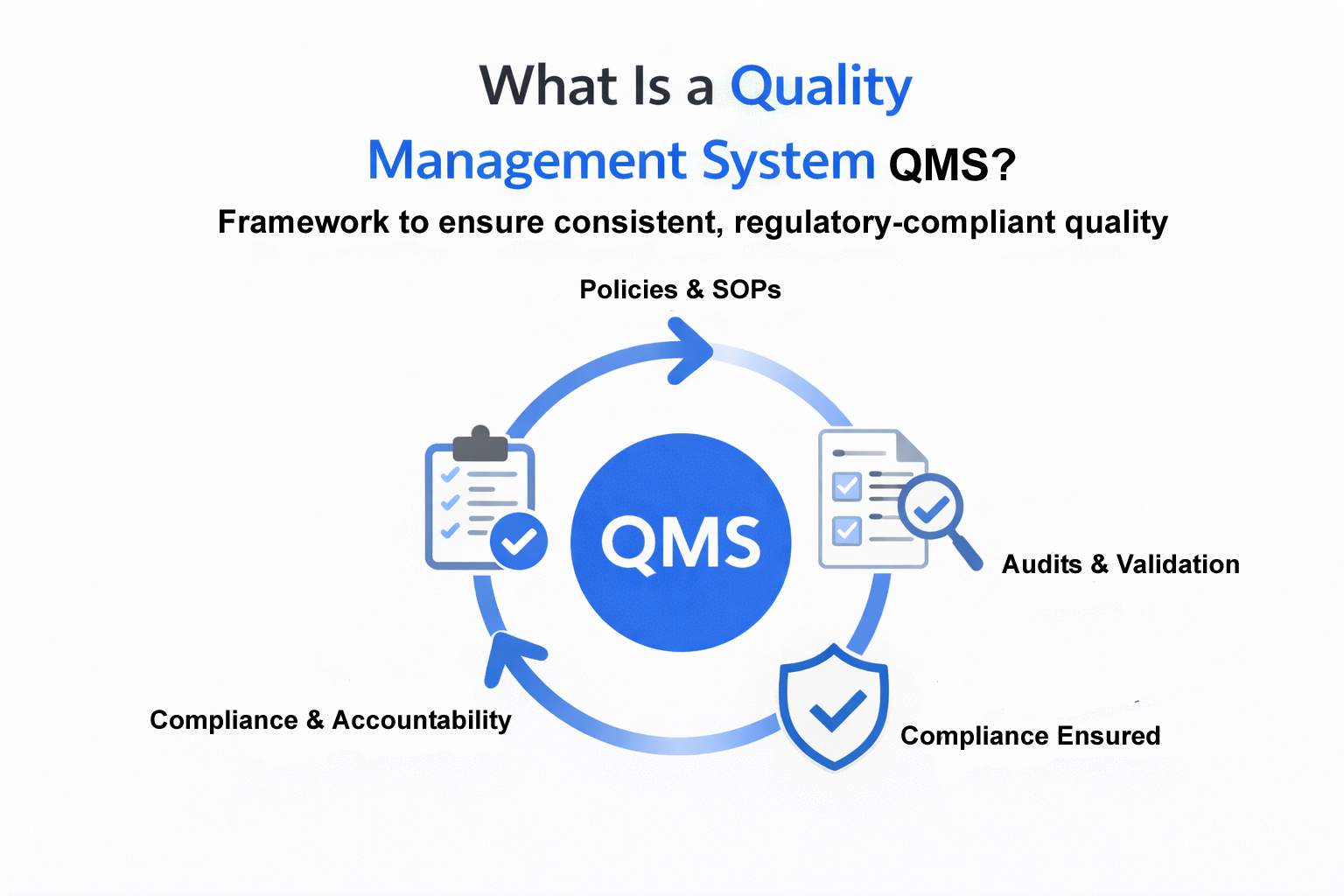
What Is a QMS (Quality Management System)?

A Quality Management System (QMS) is a structured framework of policies, processes, procedures, and records that ensures an organization consistently delivers products and services that meet customer, regulatory, and compliance requirements.

In simple terms, a QMS helps organizations:

  • Do things the right way
  • Do them consistently
  • And prove it during audits

Modern platforms like LuitBiz QMS digitize and automate these processes to improve quality, accountability, and compliance across the organization

Why Is a QMS Important?

Organizations implement a QMS to move from reactive problem-solving to proactive quality control.
A well-implemented QMS like LuitBiz QMS helps you:

  • ✅ Maintain consistent product and service quality
  • ✅ Meet ISO, GMP, FDA, IATF, and industry regulations
  • ✅ Reduce errors, deviations, and rework
  • ✅ Improve customer satisfaction
  • ✅ Pass audits with confidence
  • ✅ Enable continuous improvement

For regulated industries, a QMS is not optional - it is essential.


Core Capabilities of a Quality Management System (QMS)

A Quality Management System (QMS) typically includes the following key components:

Document Control

Document Control

Centralized control of SOPs, policies, manuals, and records with versioning and approvals.

CAPA (Corrective and Preventive Actions)

CAPA (Corrective and Preventive Actions)

Structured handling of issues to prevent recurrence and improve processes.

Audit Management

Audit Management

Planning, execution, findings, and closure of internal and external audits.

Deviation & Nonconformance Management

Deviation & Nonconformance Management

Tracking, investigating, and resolving quality deviations.

Change Management

Change Management

Controlled handling of process, product, or system changes.

Training Management

Training Management

Ensuring employees are trained on relevant procedures and standards.

Together, these components form a closed-loop quality system.

QMS and ISO 9001 - What’s the Connection?

ISO 9001 is the most widely adopted international standard for Quality Management Systems.

It requires organizations to:

  • ✅ Define processes
  • ✅ Control documents
  • ✅ Monitor performance
  • ✅ Address risks and opportunities
  • ✅ Demonstrate continual improvement

A QMS provides the structure and evidence needed to comply with ISO 9001 and related standards such as:

  • ✅ ISO 13485 (Medical Devices)
  • ✅ IATF 16949 (Automotive)
  • ✅ GMP (Pharma & Life Sciences)
  • ✅ FDA 21 CFR Part 11

For regulated industries, a QMS is not optional - it is essential.

Manual QMS Vs Digital QMS Software


Manual QMS (Excel, Email, Files) Digital QMS (LuitBiz QMS)
Scattered documents Centralized system
No version control Controlled revisions
Audit panic Audit-ready anytime
Human errors Automated workflows
Limited visibility Real-time dashboards

A digital QMS reduces risk, saves time, and scales with your organization.

Who Needs a Quality Management System?

A QMS is essential for organizations in:

  • Manufacturing
  • Pharmaceuticals & Life Sciences
  • Medical Devices
  • Healthcare
  • Automotive & Aerospace
  • Engineering & EPC
  • IT & Software (ISO-certified firms)
  • Export-oriented businesses

If your organization is audited, regulated, or quality-driven - you need a QMS.

What Is QMS Software?

QMS software (like LuitBiz QMS) is a digital platform that integrates and automates all quality processes into a single system.

With LuitBiz QMS, organizations can:

  • Control documents
  • Manage audits and CAPA
  • Track deviations and changes
  • Ensure employee training compliance
  • Maintain complete audit trails

All in one secure, cloud-based platform.

Benefits of Using LuitBiz QMS

  • Centralized quality processes
  • Built-in ISO & GMP readiness
  • Role-based access control
  • End-to-end audit trails
  • Faster audits and certifications
  • Scalable for SMEs to enterprises

Ready to Implement a Modern QMS?


A Quality Management System is not just about compliance - it is about building trust, efficiency, and long-term growth.

LuitBiz QMS helps organizations simplify quality management while staying audit-ready at all times.

See LuitBiz QMS in Action

Secure. Compliant. Built for growth

Frequently Asked Questions

What does QMS stand for?

QMS stands for Quality Management System, a framework used to manage and improve quality across an organization.

Is QMS mandatory for ISO 9001?

Yes. ISO 9001 requires organizations to establish, implement, and maintain a Quality Management System.

What industries require a QMS?

Manufacturing, pharma, healthcare, automotive, medical devices, and ISO-certified industries require a QMS.

What is the difference between QMS and ISO 9001?

ISO 9001 is a standard, while a QMS is the system used to meet that standard.

Can small businesses use QMS software?

Yes. Modern QMS software like LuitBiz QMS is designed for SMEs as well as enterprises.